China’s Electric Golf Cart industry is changing quickly in 2026. Buyers now expect quieter motors, longer range, safer charging, and stronger after-sales support. The best manufacturers must prove these claims beyond polished brochures.
Bob Lutz, a former General Motors vice chairman and experienced vehicle-industry executive, once said, “The electric car is not a fad.” His observation applies to golf mobility, but with one important qualification: an Electric Golf Cart must perform reliably in real environments. A cart used on a resort may face steep paths, wet grass, heavy passenger loads, and repeated daily charging. Laboratory figures alone cannot show that experience.
This guide examines China’s top 10 Electric Golf Cart manufacturers through practical and verifiable indicators. These include battery options, motor performance, chassis design, controller quality, production capability, warranty terms, export experience, and dealer support. It also considers customization, because fleet buyers may need cargo beds, weather enclosures, lithium batteries, or wheelchair-accessible layouts.
The ranking is not absolute. Markets change.
Some manufacturers communicate better than they manufacture. Others build dependable carts but provide limited English documentation. That difference matters. A low purchase price can become expensive when spare parts arrive slowly or technicians lack training.
Readers should treat this list as a starting point, not a final purchasing decision. Factory audits, sample testing, service records, and written warranty conditions still deserve attention. The strongest supplier is rarely the loudest one. It is usually the company that delivers consistent carts after the first shipment.
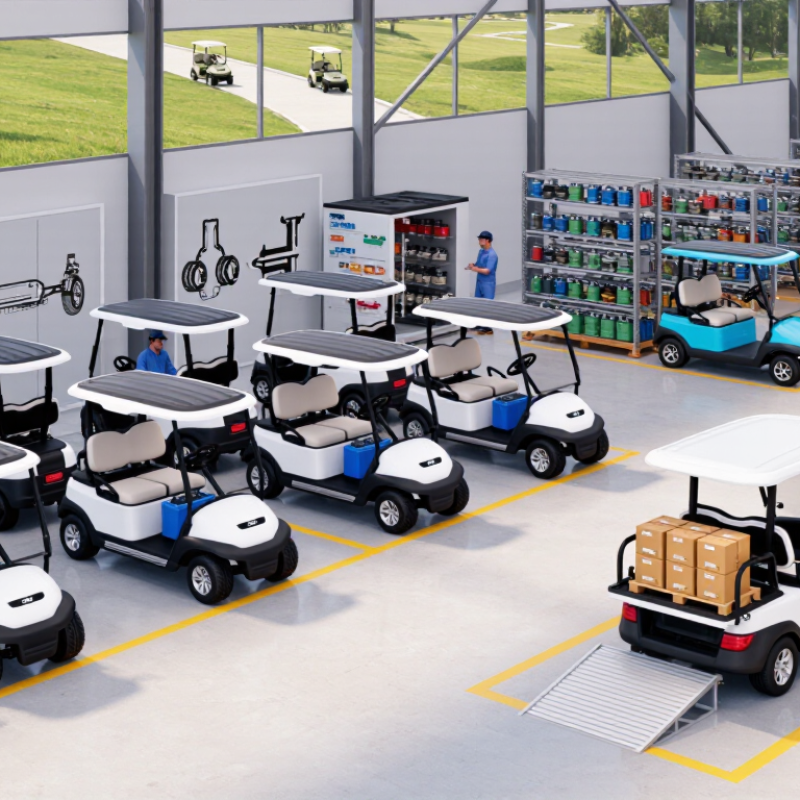
China’s electric golf cart industry is entering 2026 with broader product demand and tougher buyer expectations. Manufacturers now serve resorts, residential communities, campuses, industrial parks, and municipal transport projects. The strongest suppliers usually offer more than attractive vehicle designs. They provide battery documentation, load testing, spare parts, and responsive technical support.
A useful top-ten evaluation should examine production capacity, engineering depth, and export experience. Battery safety remains central, especially for models operating in hot climates or on uneven roads. Buyers should also check motor performance, braking distance, charging time, corrosion protection, and controller reliability. A cart that performs well during a showroom test may struggle after months of daily use. Real operating data matters more.
China’s manufacturing base supports flexible configurations and competitive pricing in 2026. Many factories can adjust seating layouts, roof structures, tires, lighting, and cargo equipment for different applications. However, the market is not perfectly transparent. Published production figures and efficiency claims can be difficult to verify. That weakness deserves attention. Factory audits, sample inspections, warranty terms, and documented after-sales procedures can reduce purchasing risks. Local service coverage may still differ sharply between regions, even when products appear similar. For international buyers, compliance records and clear communication are becoming as important as unit cost.
They serve resorts, residential communities, campuses, industrial parks, and municipal projects. Seating, tires, lighting, and cargo equipment can be adjusted. Application fit matters more than appearance.
Check payload, motor output, ground clearance, braking distance, and charging time. Review battery capacity and controller reliability. Test the cart on uneven roads, not only indoors.
Two-seat models may cost about US$3,000–6,000 before shipping and duties. Utility and six-seat models can exceed US$10,000. Cheap quotes may exclude spare parts, testing, or warranty support.
Battery safety affects hot climates, steep paths, and daily charging. Documents should match the exact cell, battery pack, and vehicle model. Small paperwork gaps can create large concerns.
Request market-specific safety, electromagnetic, chemical, and battery transport documents. Also check quality-management certification and independent inspection records. A certificate alone does not prove vehicle reliability.
Review factory audits, welding quality, braking tests, water protection, and sample consistency. Ask for load-testing records with four adults onboard. Real data beats a polished showroom video.
Assess product quality, safety, production capability, service support, and total value. A practical weighting could be 30%, 25%, 20%, 15%, and 10%. The weighting is imperfect.
Confirm spare-parts availability, warranty procedures, technical response times, and regional service coverage. Ask how battery or controller failures are handled. Similar vehicles may receive very different support.
Compare energy use, maintenance hours, battery replacement intervals, and delivery performance. A lower purchase price may become expensive after repeated repairs. Cost claims can be incomplete.
No. A cart may show strong range during a short test, then weaken after months of daily use. Independent sample testing is necessary. That conclusion is uncomfortable, but useful.
China’s electric golf cart industry is entering 2026 with stronger demand from golf resorts, residential communities, hotels, campuses, airports, and industrial facilities. This article presents a practical overview of the market and introduces ten leading Chinese manufacturers based on product quality, engineering capabilities, manufacturing scale, customization services, export experience, safety performance, certifications, and after-sales support. It focuses on how different manufacturers develop vehicles for passenger transport, utility work, tourism, and light commercial applications.
Readers will also find a clear comparison of vehicle configurations, battery technologies, driving range, charging systems, comfort features, safety designs, production standards, certification coverage, and general pricing levels. Rather than promoting any individual company, the guide explains how to evaluate an Electric Golf Cart manufacturer according to application requirements, operating environment, budget, delivery capability, warranty terms, spare-parts availability, and long-term service reliability. These insights can help international buyers make more informed and efficient sourcing decisions in China’s competitive 2026 market.

 XXCART